Technical Info

The engineering behind a better cut

A practical knowledge base on industrial knife materials, blade types, cutting geometries, application areas and proven methods to raise cutting performance — compiled by Snijer engineers and rephrased from recognised industry sources.

Industrial knife materials

The base material determines how long an edge lasts, which loads it tolerates and which materials it can cut cleanly. These are the seven families we specify most often, with typical industry values.

Industrial knife materials

01High-carbon high-chromium tool steel (D2 / 1.2379)

Composition
Approx. 1.55% carbon, 11–13% chromium, plus molybdenum and vanadium; hardened to 58–62 HRC.
Benefits
High wear resistance and compressive strength at moderate cost; dimensionally stable after heat treatment and straightforward to regrind.
Applications
Shear and guillotine blades, granulator knives, metal slitting, paper and cardboard cutting.

02High-speed steel (M2 / 1.3343)

Composition
Approx. 6% tungsten, 5% molybdenum, 4% chromium and 2% vanadium; working hardness 62–65 HRC.
Benefits
Retains hardness at elevated temperatures (red hardness) and combines toughness with wear resistance — tolerant of shock, vibration and minor misalignment.
Applications
High-speed slitting, packaging machine knives, punch blades and applications with impact load.

03Tungsten carbide (WC-Co)

Composition
Tungsten carbide grains sintered in a cobalt binder (typically 6–12% Co); hardness approx. 1,400–1,800 HV.
Benefits
Extreme wear resistance — edge life often 10–20× longer than steel in abrasive webs; very high compressive strength, but brittle and costlier to grind.
Applications
Abrasive plastic films (PP, filled films), fibreglass, battery electrode foils, high-volume converting.

04Martensitic stainless steel (440C / 1.4125, 1.4034)

Composition
Chromium 13–17% with up to approx. 1% carbon (440C); hardenable to roughly 54–58 HRC.
Benefits
Corrosion resistance and hygienic, food-contact-safe surfaces; tolerates wash-down cleaning and aggressive detergents.
Applications
Food processing (meat, vegetables, bakery), tray-sealer knives, pharmaceutical and medical cutting.

05Powder-metallurgy tool steel (CPM / ASP grades)

Composition
Atomised tool steel with a very fine, uniform carbide distribution; high-vanadium grades for severe abrasion.
Benefits
Combines near-carbide wear resistance with far better toughness and grindability than solid carbide; very consistent edge quality.
Applications
Pelletizer and granulator knives, recycling of reinforced plastics, long-run converting.

06Technical ceramics (ZrO₂) & hard coatings (TiN, TiCN, DLC, ceramic)

Composition
Solid zirconium-oxide blades, or steel/carbide substrates carrying PVD/CVD layers only a few micrometres thick.
Benefits
Ceramic is chemically inert, metal-free and self-sharpening in soft webs. Coatings are far harder than steel: they protect the ground geometry, cut friction and multiply edge life.
Applications
Ceramic: soft, degradable films and medical media. Coatings: abrasive or printed films, adhesive webs and high-speed converting.

07Spring steel (50CrV4 / 1.8159, AISI 6150)

Composition
Approx. 0.5% carbon with chromium and vanadium; hardened and tempered to 42–52 HRC for high elastic resilience.
Benefits
Excellent toughness and fatigue resistance under repeated impact and flexing; resists chipping and cracking where rigid steels would fracture.
Applications
Hold-down and pressure knives, scraper and spring blades, vibrating and oscillating cutters, shock-loaded trimming knives.

Industrial knife types

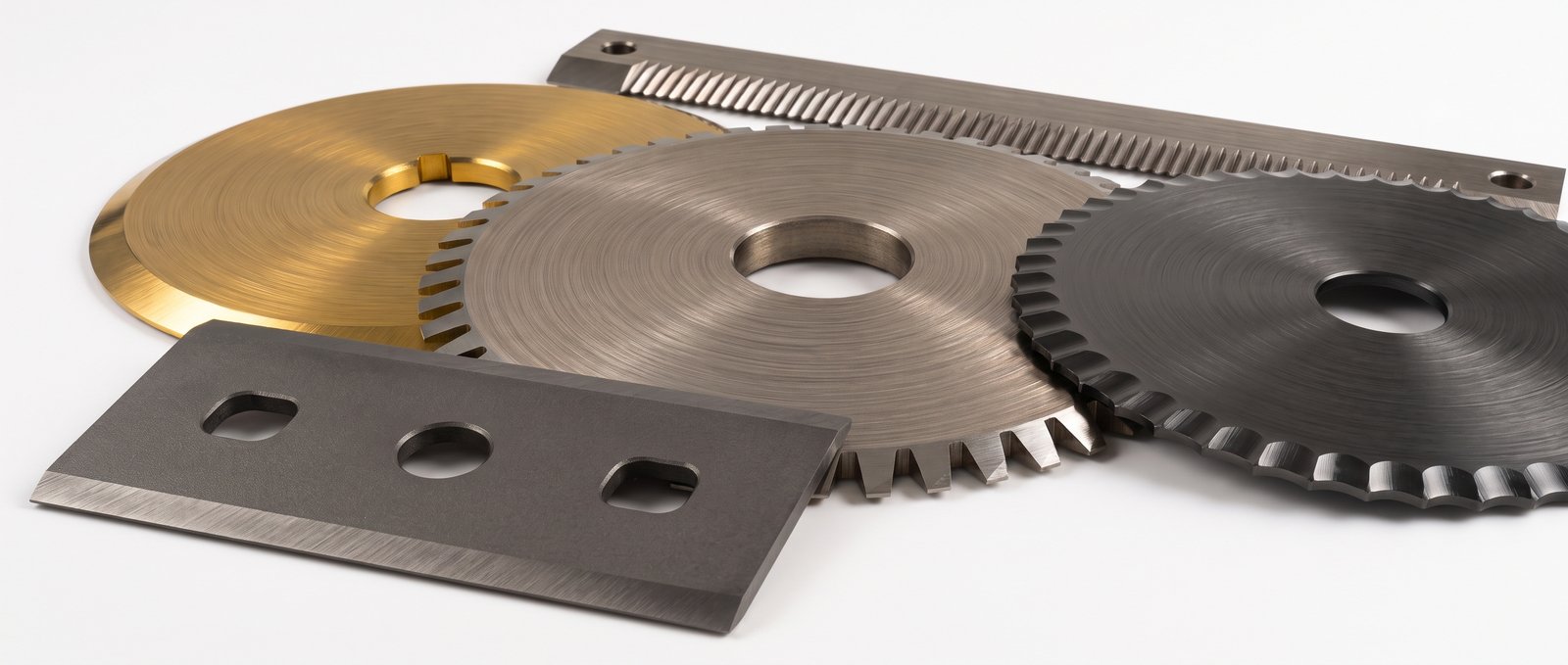
Each cutting principle imposes its own knife form. These are the eight types we engineer and manufacture most frequently.

01

Circular slitting knives

Rotary top and bottom knives for shear slitting of film, foil, paper and nonwovens; available with keyways, drive holes and single or double bevels.

02

Straight & guillotine blades

Linear shear blades for cut-to-length, cross-cutting and trimming of sheet, web and stacked material.

03

Score & crush cut knives

Dished or radiused knives that press the web against a hardened anvil roller — robust and simple for paper, board and nonwovens.

04

Razor slitter blades

Ultra-thin industrial razor blades (e.g. 57 × 19 × 0.38 mm) for the finest, dust-free cuts in light films; slotted, 3-hole and injector formats.

05

Perforation & toothed blades

Ground tooth profiles (V, U, scalloped) that create controlled tear lines in packaging, labels and hygiene products.

06

Granulator & pelletizer knives

Rotor and bed knives for size reduction of plastics; die-face and strand pelletizer blades for polymer production.

07

Food processing & tray-sealer knives

Stainless slicer, dicer and contour knives, plus heat-resistant sealing-frame blades for packaging lines.

08

Punch, die & custom machine knives

Punch blades, steel-rule dies and fully custom geometries manufactured to drawing for special machines.

Cutting geometries

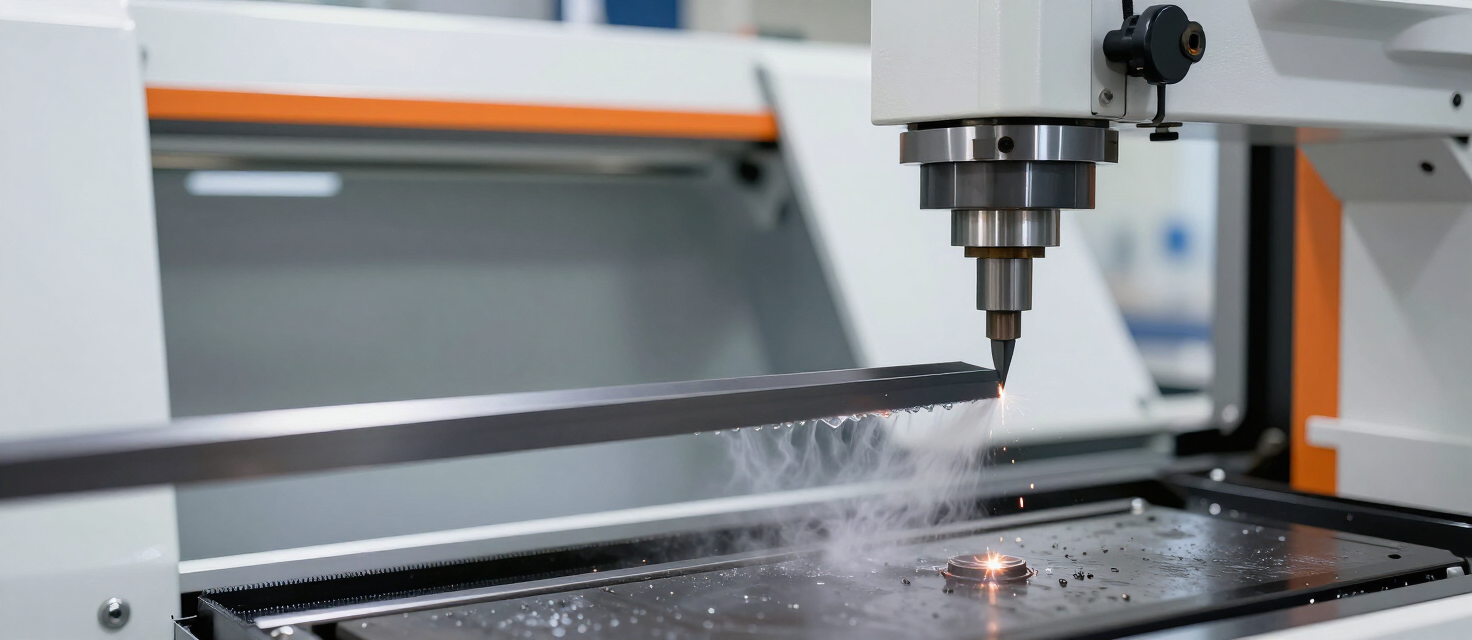
Geometry decides how the edge enters the material: cutting force, edge stability, heat and dust. The most important variants at a glance.

Single bevel

One ground face; the flat side runs against the counter-knife or product guide. Precise, easy to regrind, standard for many shear cuts.

Double bevel

Symmetrically ground from both sides; centres the cutting force and suits free cutting of webs and soft materials.

Compound bevel (primary + secondary)

A steep primary bevel carries a finer secondary edge angle, combining edge strength with low cutting force.

Hollow grind

Concave ground faces reduce friction and heat in deep cuts; common on food slicers and thin cross-section knives.

Flat / V-grind

Straight tapered faces running to the edge; robust and universal, easy to measure and reproduce.

Edge radius, clearance & mounting features

Micro-radii stabilise the edge against chipping; clearance angles prevent heel drag; keyways, slots and holes define drive and positioning.

Looking for a specific geometry?

Detailed drawings, bevel angles and custom geometries are engineered per application. Browse the geometry library and request custom manufacturing directly at www.snijerblades.com.

VIEW BLADE TYPES

Application areas

Industrial knives work in almost every production environment. Where we most often deliver measurable improvements:

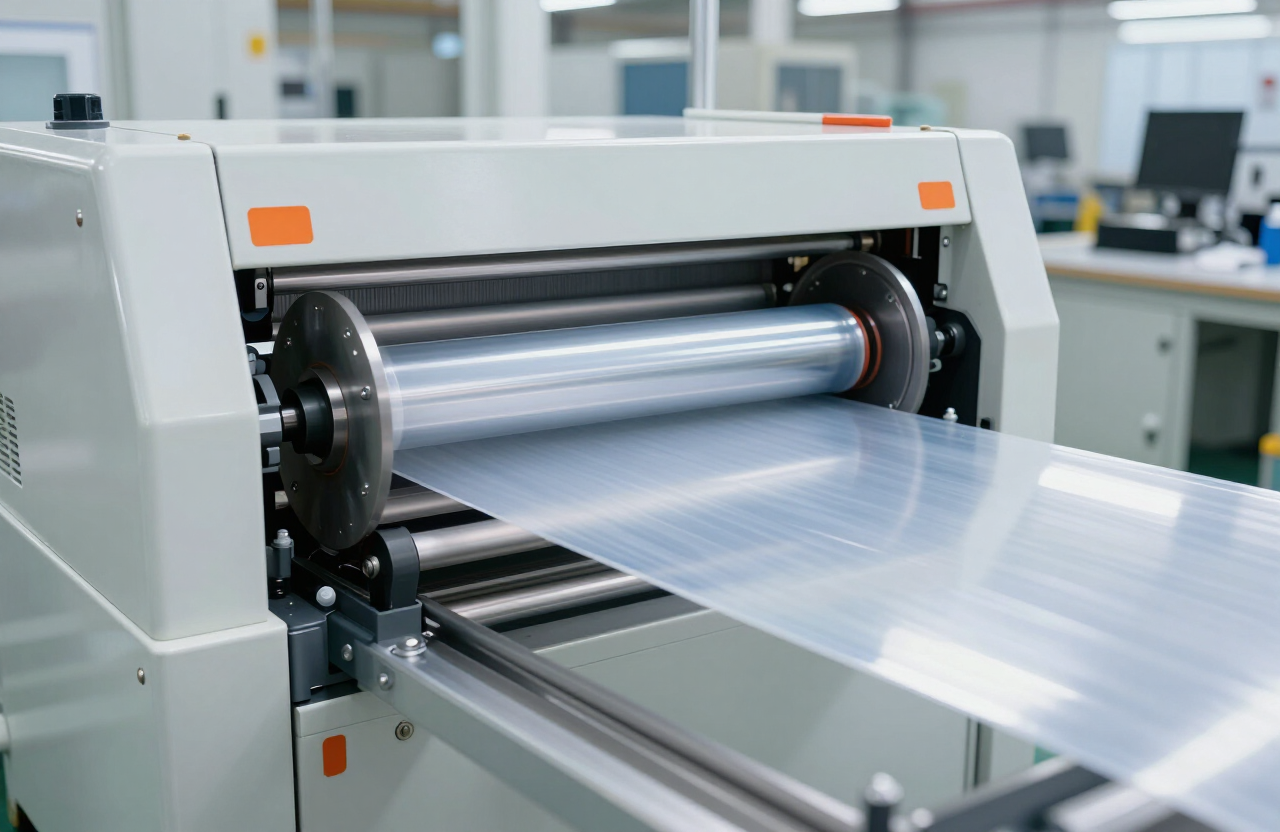
Circular knives slitting a plastic film web on a converting line

Film & foil converting

Shear and razor slitting of BOPP, PET, PE, stretch and laminated films, plus aluminium and copper foils.

Paper, cardboard & corrugated

Slitting, cross-cutting and die-cutting of paper, board and corrugated packaging.

Plastics & recycling

Granulation, pelletizing and size reduction of production scrap, PET, PP and reinforced compounds.

Food processing

Slicing, dicing and portioning of meat, vegetables, bakery and confectionery with hygienic stainless knives.

Packaging machines (VFFS/HFFS)

Sealing-jaw, cut-off and perforation knives for vertical and horizontal form-fill-seal lines.

Metal sheet & foil

Shearing and slitting of sheet metal, battery electrode foils and precision shim stock.

Textile & nonwovens

Cutting of fabrics, technical textiles, wipes and hygiene nonwovens.

Rubber, tyre & composites

Trimming and cutting of rubber, tyre components, fibreglass and composite prepregs.

Six methods to improve cutting performance

Five proven levers — plus disciplined setup — raise the performance and service life of industrial knives. They build on each other: start with design, then upgrade material and surface.

  1. 01

    Optimise the blade design first

    Cut quality is decided by the basic specification: diameter, thickness, bevel and sharpness. Dust usually signals a dull edge — sharpen or re-specify. Burrs and flakes on foil often signal an over-sharpened edge — a larger grinding angle can solve it.

  2. 02

    Use coatings to protect the edge

    Ceramic, TiN or low-friction coatings are far harder than steel and preserve the ground geometry. On abrasive films a coated razor blade can run for weeks where an uncoated one lasts minutes; low-friction coatings help thin, fast webs.

  3. 03

    Step up to advanced materials

    Where coatings are not enough, solid tungsten carbide excels on hard, abrasive plastics such as PP, while solid ceramic delivers extreme life on soft, degradable films — at the cost of careful handling.

  4. 04

    Mirror-polish the cutting edge

    Polishing a coated edge creates an extremely fine surface topography. On thin metal foils and in medical applications this measurably reduces flakes, burrs and dust.

  5. 05

    Lubricate when cutting metal foil

    A minimal amount of suitable oil or lubricant lowers friction and frictional heat at the contact point, prevents foil stretching and produces a cleaner, burr-free edge on aluminium and copper.

  6. 06

    Control setup & maintenance

    Correct knife overlap, cant angle, holder rigidity, web tension and a planned regrinding schedule keep the specified geometry working. Even the best blade fails in a poor setup.

Sources & further reading

Technical values on this page are typical industry figures, rephrased in our own words. Always validate parameters for your specific machine, material and operating conditions.

Snijer

Industrial knives & cutting consulting, engineered in the Netherlands.

Contact

Manufacturing

Custom industrial knives and geometries:

www.snijerblades.comVIEW BLADE TYPES

Legal

  • —

Disclaimer

The technical information published on this website is provided for general guidance only and is compiled with the greatest possible care. Snijer accepts no liability for any direct or indirect damage, loss or injury resulting from the use or application of the data, recommendations or values shared on this site. Cutting parameters, materials and geometries must always be validated for your specific machine, material and operating conditions.

© 2026 Snijer. All rights reserved.